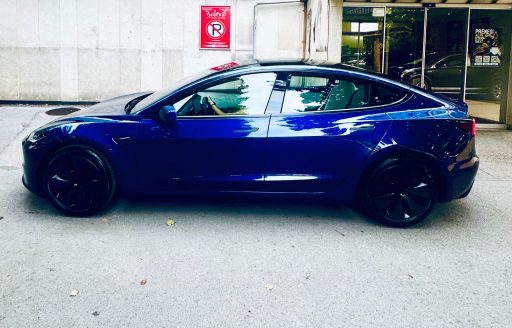
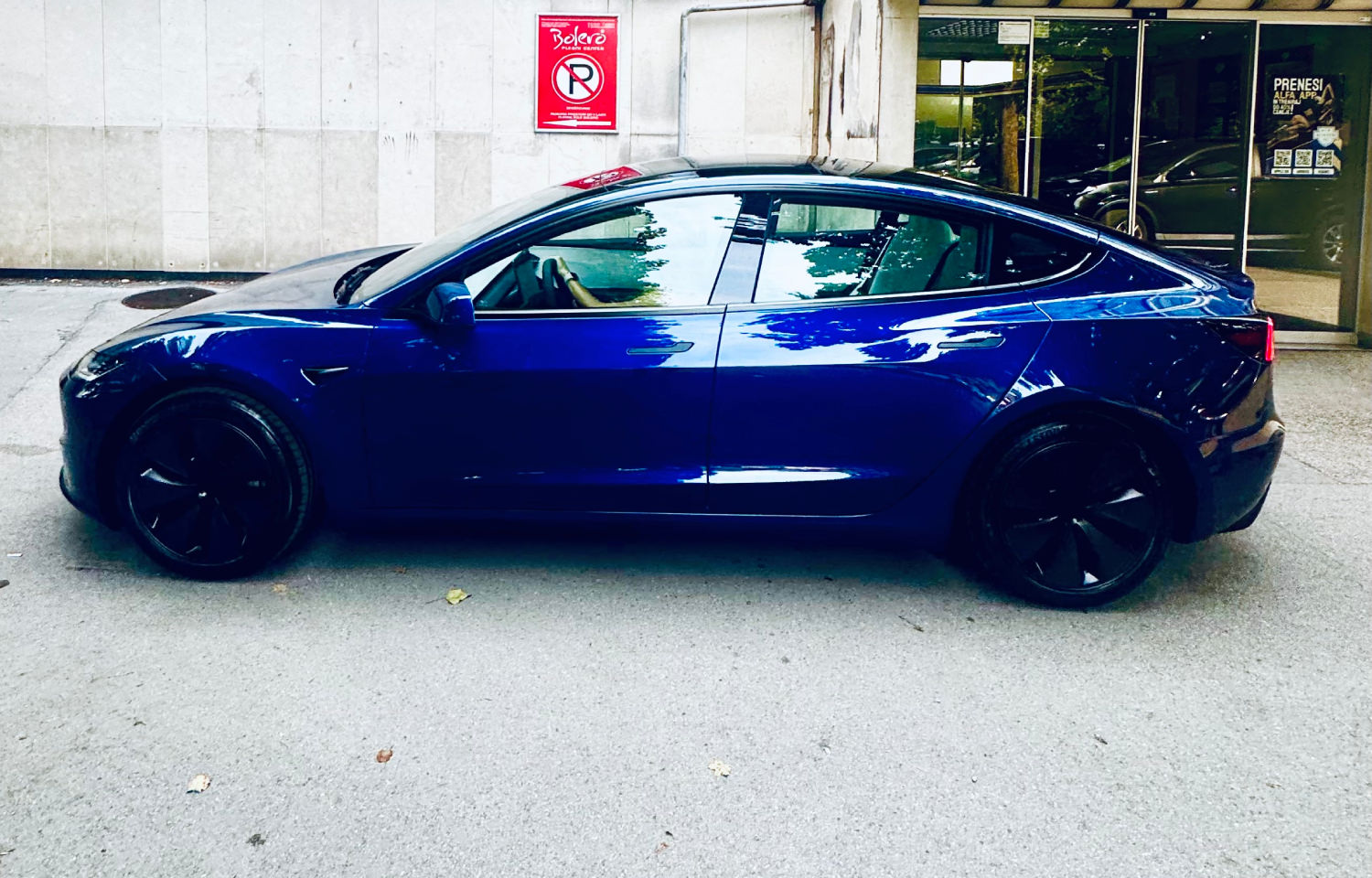
I no longer think about the fact that I drive an electric car. I just drive a car. I have been living with my second Tesla for two years now, and it has already covered 65,000 kilometres. It still hasn’t caught fire, the battery hasn’t died, and I haven’t ended up stranded on a motorway in winter because the cold somehow magically swallowed all the electricity. I also haven’t spent the last two years sitting at charging stations waiting for my journey to continue, nor do I drive at 90 km/h behind trucks on the motorway just to make it to the next charger. What actually happened is far more boring. Driving an electric car has simply become driving a car, except that in my case it is considerably, considerably cheaper.
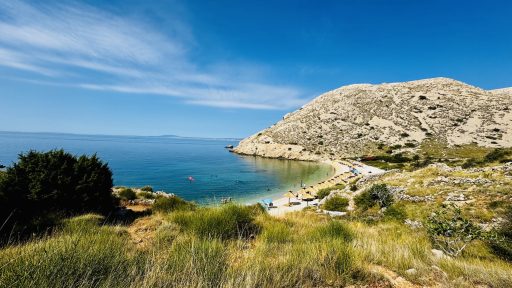
My Tesla has been everywhere during those two years. I have driven it all over Slovenia, countless times to the island of Krk, through Croatia, Italy, Austria and Hungary. I even took it on a road trip of more than 2,500 kilometres through Italy, visiting Rome, Tivoli, Gaeta, Naples, Caserta, Sorrento and Positano, and at no point did I have a problem simply because I was driving an electric car. For those more than 2,500 kilometres, I spent around €125 at Tesla Superchargers, and it was rather amusing to realise that Italian motorway tolls cost me more than the electricity I used to drive the entire route.
I have taken the same car to Florence and Saturnia for New Year, I regularly drive 500 or 600 kilometres in a single day, and whenever I feel like going to Krk, I simply go. At no point do I think about changing my plans because I happen to be driving an electric vehicle.
The famous “range anxiety” that is most enthusiastically discussed by people who do not actually own an electric car disappeared for me fairly quickly. I enter my destination into the navigation system and drive. The car calculates where I need to charge, how long the stop will take and what battery percentage I will have when I arrive. When I reach a Supercharger, I plug the car in, go to the toilet, grab something to drink, check my phone and, more often than not, the car is ready before I am.
At my age, I also admit that I no longer fully understand the obsession with driving 800 or 1,000 kilometres without stopping, as if this were the ultimate proof of freedom offered by a diesel engine. I used to do something similar myself, but these days a twenty-minute break after several hours behind the wheel seems considerably more sensible than proving that my bladder has a longer range than my battery.
But enough philosophy. There is something much easier to measure, and that is money.
Over the past two years, I have driven 65,000 kilometres. If I had covered the same distance in a diesel car consuming an average of 6.5 litres per 100 kilometres, I would have used approximately 4,225 litres of diesel. Using a very rough but perfectly realistic average diesel price of around €1.56 per litre, those 65,000 kilometres would have cost me roughly €6,580 in fuel alone.
With the Tesla, the calculation looks very different. My average energy consumption is around 145 Wh/km, which means that over 65,000 kilometres I have used approximately 9,425 kWh of electricity. Because I charge mostly at home and have been paying around €0.09 per kWh, that comes to roughly €850. Even after accounting for charging losses and rounding the figure upwards, I end up at around €930.
So on one side there is approximately €6,580 for diesel, while on the other there is around €930 for electricity. The difference is more than €5,600. I drive around and save money at the same time. Slightly perverse logic, isn’t it?
I am not claiming that everyone can charge at home for nine cents per kilowatt-hour, because they cannot, and not everyone even has the option of home charging, which changes the calculation considerably. I do have that option, however, which is why I am writing about my own experience rather than inventing some universal truth that supposedly applies to everyone, as people arguing in favour of diesel cars often like to do.
Even if I use a much higher average household electricity price of around €0.215 per kWh, those 65,000 kilometres would still have cost around €2,000 in electricity. That is still considerably less than the roughly €6,600 I would have left at petrol stations driving a diesel car.
I do not need to prove that my Tesla is going to save the planet, because it will not. Battery production has an environmental footprint, car production has an environmental footprint, and electricity does not magically appear from a socket with the help of fairies and elves. I am equally uninterested in taking part in the endless war between diesel drivers and electric-car owners, where one side insists that the battery will die tomorrow while the other acts as though the internal combustion engine belongs in the Stone Age.
What interests me is something far more ordinary. Does the car do its job? It does. Can I go wherever I want with it? I can. Does it limit me? It does not. Do I have to think about charging? Considerably less than I used to think about stopping for fuel.
That is probably the main reason why, after two years, I no longer think of my Tesla as an electric car. To me, it has simply become a car. When I go to Krk, I go to Krk. When I go to Italy, I go to Italy. When I have 500 kilometres ahead of me, I drive 500 kilometres. I do not check the weather forecast because of the battery, I do not plan every journey three days in advance, and I do not sit behind trucks at 90 km/h trying to preserve the last few electrons.
Of course, a Tesla is not a perfect car. Far from it. Some solutions are brilliant, others are completely ridiculous, and with some of them I genuinely wonder what was ever wrong with traditional buttons. Tesla as a company can occasionally raise your blood pressure as well, while Elon Musk is an entirely separate story.
After 65,000 kilometres, however, I can only describe my own experience. My Tesla has never left me stranded because it is electric, and it has taken me everywhere I wanted to go. Many years ago, I was convinced that an electric car simply wasn’t for me, but sometimes you have to give new technology a chance before deciding what you think about it. Then, occasionally, you discover that doing so was actually one of the better decisions you made, especially at a time when oil prices are heading through the roof.