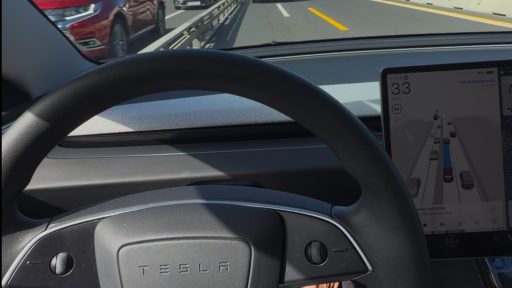
Tesla FSD (Supervised) received regulatory approval for use in Slovenia on September 7, and yesterday my Tesla greeted me with a notification that a new software update was ready to install. I was curious to see how Tesla FSD Supervised would actually perform in real-world traffic on the streets of Ljubljana, so there was no question about whether I would install it. Ljubljana and its surroundings were in complete traffic chaos yesterday, with queues, congestion, nervous drivers, cyclists, pedestrians and plenty of honking, which meant I could hardly have chosen a better day for my first proper FSD Supervised test. What I hadn’t expected was how nervous I would be before turning it on. Driving on the left in Scotland caused me less stress than supervising a car that was about to drive itself through Ljubljana traffic, but there was only one way to find out how well it actually worked.
FSD Supervised is not autonomous driving in the true sense of the word. The car may steer, accelerate, brake, change lanes, navigate intersections and follow the planned route, but the driver must remain attentive at all times, monitor what the system is doing and be ready to take control immediately. The responsibility remains with the driver, so there is no reading a book, sleeping or writing a blog post while the Tesla drives you around Ljubljana. Even with all of that in mind, the first moment when you allow the car to drive itself through a busy city feels very strange.
Once the software update had finished installing, I had to watch a short video explaining how the system works and answer a couple of questions before I could activate it. The cabin camera monitors whether the driver is paying attention to the road rather than staring at a phone, and if you stop paying attention the system warns you. Ignore those warnings repeatedly and you may temporarily lose access to FSD. In other words, Tesla may be doing the driving, but it still expects you to behave as if you are responsible for the car, because you are.
My first drive with Tesla FSD Supervised took me from Bežigrad to Fužine, past BTC and straight through all the congestion Ljubljana had to offer that day. It was actually close to an ideal real-world test because, if I had deliberately tried to choose a route where as many unpredictable things as possible could happen, I would have struggled to find a better one. There were cyclists, pedestrians, traffic jams, traffic lights, busy intersections, cars forcing their way into lanes, drivers changing lanes at the last possible moment and basically the complete collection of everything that makes driving through Ljubljana such an interesting experience. You enter the destination into the navigation, activate FSD and then watch what happens.
For the first few minutes, the whole experience felt uncomfortable, not because the Tesla was doing anything particularly wrong, but because I simply did not trust the technology yet. What felt even stranger was having to supervise a system that was supposed to be driving for me. I watched every situation carefully and was constantly ready to grab the steering wheel or hit the brake. I kept wondering whether the car had seen the cyclist, whether it would brake early enough, whether it understood that the driver in front of me was about to do something stupid and whether it would react at an intersection the same way I would. Basically, I found myself swearing at the Tesla in much the same way I usually swear at other drivers.
Then ten minutes passed, followed by fifteen and then twenty, and slowly I realised that there was actually very little to be afraid of. Not because the technology is magical or incapable of making mistakes, but simply because the Tesla drives surprisingly well and, in many situations, considerably better than what we have become accustomed to seeing from drivers on Slovenian roads.
It stops properly at a STOP sign, which naturally means somebody behind you will eventually start honking because apparently respecting traffic rules is considered suspicious behaviour. When a cyclist approaches on a cycle lane, Tesla slows down early and lets them pass. When traffic ahead begins to stop, it does not wait until the final few metres before braking, but reduces its speed calmly and gradually. Most noticeably of all, it maintains a proper safety distance from the vehicle in front.
That safety distance quickly made me notice something we all know but have apparently become so used to that we barely register it anymore. If you leave enough space in front of your car, someone will almost certainly interpret that space as a personal invitation to squeeze into it. Because Tesla does not sit on the bumper of the vehicle ahead and instead maintains a normal safety distance, it does not take long before another driver decides that those extra few metres were created specifically for them.
That is exactly when the situations you are initially afraid of begin to happen. Somebody else does something stupid and your first instinct is that Tesla will react badly, so your hand automatically moves towards the steering wheel because you are convinced you will have to save the situation. Then you wait another second and realise that Tesla has already understood what is happening, analysed the situation, reduced its speed, created enough space and dealt with everything without any drama whatsoever.
After several situations like that, I slowly began to understand that the biggest problem for FSD in Slovenia might not be the technology at all. The much bigger problem could be the drivers around it, including those who sometimes drive exactly the way I do myself.
We have become accustomed to all kinds of improvisation on Slovenian roads, from driving without indicators and leaving almost no safety distance to cutting into lanes, blocking intersections and changing lanes far too late. There are so many small violations that we have stopped treating them as anything unusual. Tesla, on the other hand, tries to follow the rules, and that is precisely why sitting behind the wheel while FSD is active feels so strange.
After about twenty minutes, I noticed that I had become considerably more relaxed. I was still watching the traffic and remained ready to take control, but I was no longer expecting something to go wrong in every situation. Instead, I slowly started feeling as though I was watching the kind of driving that should actually be normal: calm and predictable, without unnecessary aggressive acceleration or braking, while respecting traffic rules and paying attention to everyone else on the road.
That was probably the strangest part of the entire experience. It was not the fact that the car could turn the steering wheel or brake on its own, because we have been using various driving assistance systems for years. What felt different was watching a car drive through Ljubljana, react to traffic and make decisions on its own while I sat behind the wheel and gradually accepted that I could let it handle one more intersection, and then another one after that.
What still fascinates me is that this is exactly the same car I have owned for two years. I did not take it to a service centre, nobody installed additional sensors and there was no new box costing several thousand euros hidden somewhere inside the car. I received a notification, installed a software update and the next day my car could do something it could not do the day before. That remains one of the most unusual aspects of owning a Tesla compared with a traditional car. Most cars simply become older as the years pass, while with a Tesla you occasionally wake up in the morning and discover that your two-year-old car has gained a feature that only a few years ago would have sounded like science fiction.
Of course, FSD Supervised is still nowhere near fully autonomous driving, and nothing about this first experience made me forget for even a second that I am ultimately responsible for what happens on the road. Still, my first FSD drive from Bežigrad to Fužine was very different from what I had expected. I expected more panic and more fear, more strange decisions by the car and, above all, many more situations where I would have to take control myself.
Instead, after about twenty minutes I came to a much more ordinary conclusion. Tesla drives the way all of us should probably drive. Perhaps that is the best description of my first Tesla FSD Supervised experience on the streets of Ljubljana. Today I am taking it towards the coast, where I want to see how it handles Slovenian highways, traffic jams and, most importantly, our motorway roadworks. I will admit in advance that this part already scares me a little.