Yesterday I wrote about testing Tesla FSD (Supervised) on the streets of Ljubljana, but that obviously wasn’t enough for me, so on Saturday morning I got into my Tesla and headed towards Malinska. Just past Bežigrad I switched on FSD and let the car take me along the Slovenian highway to Postojna, then through Pivka and Knežak all the way to the Croatian border, where Tesla automatically disabled the system because I was entering a country where FSD is not yet available. What I really wanted to know was how Tesla FSD would behave on Slovenian highways, in traffic jams and through roadworks, and whether a system like this could one day help solve the kind of traffic chaos and endless queues that have become almost normal on our roads.
You could say that I like to live dangerously and, since you only live once, there seemed to be no real reason not to try FSD on the highway as well. I still switched it on with a fairly large lump in my throat, because city streets are one thing, while a motorway at higher speeds is something completely different, but after only a few kilometres I realised that most of the tension was in my own head. Along the way I also talked to Grok, which works surprisingly well after the latest Tesla update, and asked it questions about the car, FSD and its behaviour. At moments it almost felt as if the screen in the car was becoming unnecessary, because more and more functions can simply be controlled by voice, but what interested me most was still the driving itself.
Tesla had already convinced me on city streets, but I expected the highway to be a much bigger challenge, so when the car joined the motorway I kept both hands close to the steering wheel and waited for the moment when I would have to intervene. That moment never really came, because already on Ljubljana’s ring road I got the impression that FSD knew exactly what it was doing. It respected the speed limits, did not accelerate unnecessarily, did not change lanes without reason and, most importantly, did not behave like those drivers who sit in the overtaking lane at 100 km/h and seem convinced that everyone else simply has to adapt to them.
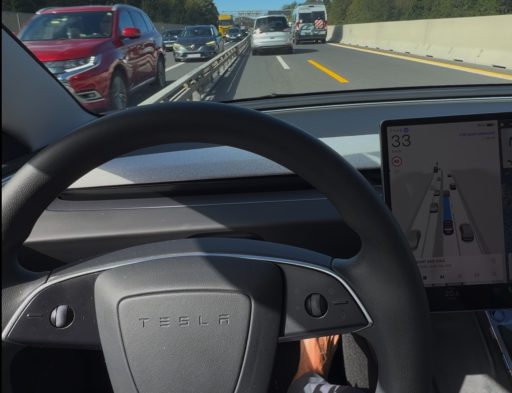
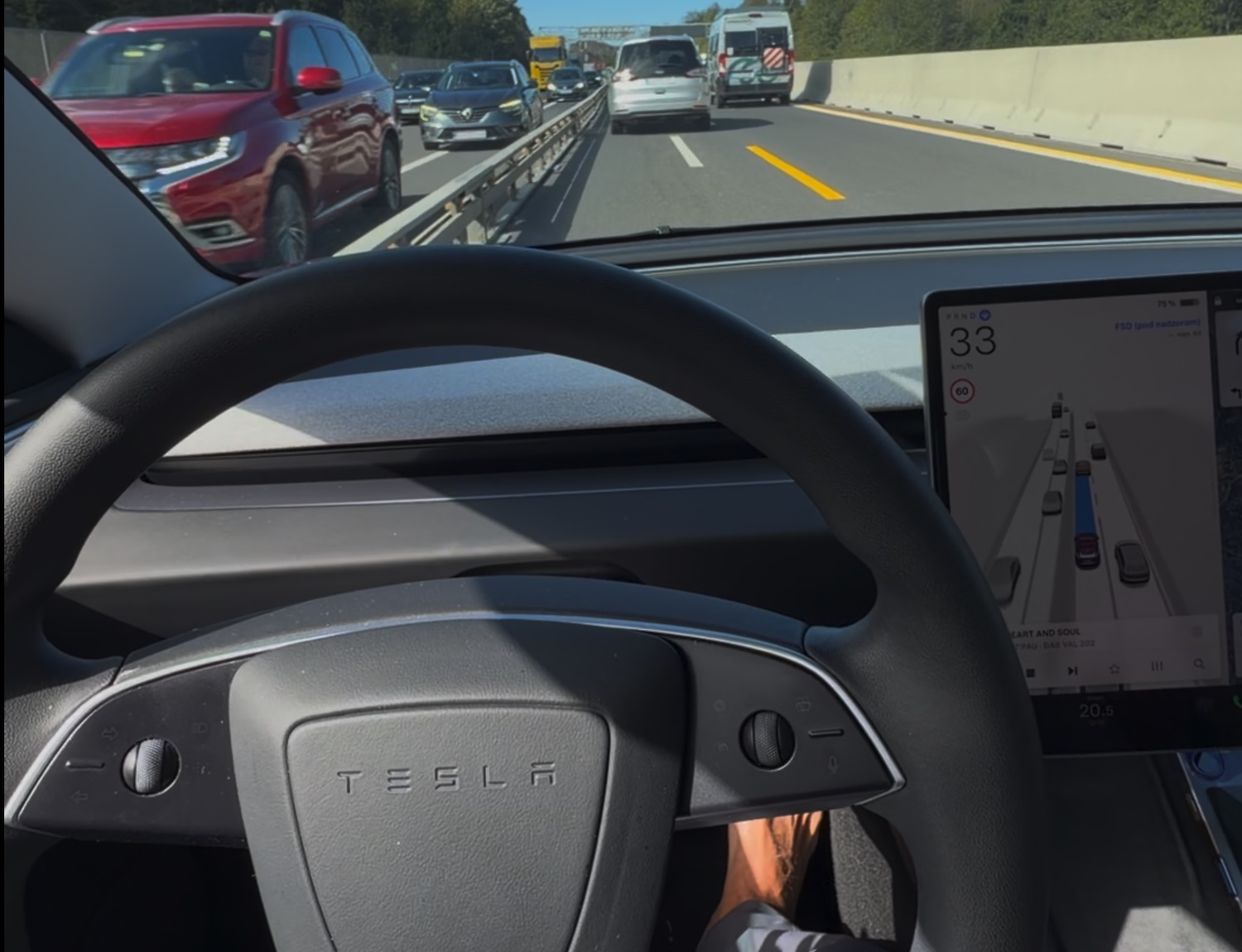
When I passed Brdo, I actually considered switching FSD off and taking control myself, but fortunately I did not, because I wanted to see what the system would do in real traffic and not only in ideal conditions. Tesla correctly chose its lane and calmly waited in the queue, because on Slovenian roads queues are apparently unavoidable, despite all the promises that someone would solve them quickly and efficiently. Nothing particularly revolutionary has happened in that area, so at least I could observe how the car behaved when traffic slowed down to the point where driving became little more than moving forward a few metres at a time.
Merging onto the highway near Brezovica was completely uneventful, and then came something that almost felt unusual on Slovenian roads, namely a proper safety distance. Tesla kept exactly the kind of distance that should be normal, but somehow rarely is, because we seem to prefer driving only a few centimetres from the bumper in front of us. I was genuinely surprised by how large the correct safety distance actually is, which also made me realise that even I had probably underestimated it in the past. Tesla was driving around 80 km/h because traffic around us was moving at roughly the same speed, while the overtaking lane was packed with cars travelling only slightly faster. FSD did not force its way into that lane because there was simply not enough space to merge safely, which once again showed the difference between an algorithm following the rules and drivers who often treat safety distance as nothing more than a recommendation.
What surprised me most was how little stress there was during the whole experience. Before Ravbarkomanda there were three almost stationary lines of traffic and Tesla chose the right-hand lane, which turned out to be the fastest one, while most drivers were crowded into the two lanes on the left. It was there that I noticed one clear problem, because Tesla does not appear to understand the Slovenian rule for creating an emergency corridor. In a traffic jam it did not move far enough towards the edge of the lane, which is something that should definitely be improved if FSD is going to work properly in local traffic conditions.
Then came the part that I expected to be the most uncomfortable, namely the roadworks. By coincidence I ended up in the overtaking lane, which was moving at around 30 km/h, and Tesla tried to move back into the driving lane, but there was simply no room because the cars there were packed too closely together. The road through the construction zone is extremely narrow, yet this did not seem to bother the system at all. Quite the opposite happened, because for the first time in a long time I actually felt relaxed in such a section. Tesla stayed perfectly centred in the lane and continued calmly all the way to the Postojna exit, without sudden corrections, hesitation or the feeling that I had to take over at any moment.
The road through Knežak towards Ilirska Bistrica has always been fun for me to drive, so I was curious to see how FSD would cope with the bends there as well. Once again it performed surprisingly well and took every corner correctly, perhaps a little slower than I normally would, but without any unnecessary movements or strange decisions. At that point I was already genuinely glad that I had left the driving to the car, because instead of constantly thinking about what I should do next, I could simply observe how the system reacted to traffic, bends, lane markings and other vehicles.
Of course I also wanted to see what would happen if I stopped paying attention and looked out of the side window for a little longer, and it only took a few seconds before the system started warning me to focus on the road and be ready to take control. Even when a driver behind me decided that flashing his headlights would somehow convince Tesla to exceed the speed limit through Koseze, FSD simply continued driving according to the rules. It did not get nervous, it did not react emotionally and it did not accelerate just because someone behind it was impatient, which is probably one of the clearest examples of why systems like this could eventually change traffic behaviour more than we realise.
As I approached the Croatian border, FSD started warning me that I would have to take control because I was entering a country where the system is not available. I took the wheel, continued the journey and realised that I was actually satisfied that I had allowed Tesla to drive me almost all the way to the seaside.
After this test, my conclusion is fairly simple. FSD (Supervised) is an impressive system and, at least based on what I experienced, it works much better than I expected. The same was already true during my drive through Ljubljana, but the motorway test showed something even more important. In many situations the problem is not Tesla or FSD, but the behaviour of other drivers who fail to keep a safe distance, change lanes without reason, ignore speed limits or simply create unnecessary chaos. An algorithm does not get angry, impatient or offended because someone overtook it, and that alone could one day make traffic calmer, safer and more predictable.
This is probably the part that stayed with me the most after the drive. Systems like FSD could eventually help reduce traffic accidents and congestion not because they are magical, but because they remove part of the human unpredictability from driving. If cars maintain the correct distance, merge properly, respect speed limits and stop changing lanes without a reason, traffic flow could become much smoother. Humans will still have to supervise the systems, but their role could slowly shift from constantly controlling the vehicle to monitoring what the algorithms are doing.
So, to answer the question from the title, yes, FSD (Supervised) could probably help solve at least part of Vrtovec’s traffic problem, although he has apparently decided that subsidies for electric vehicles are no longer particularly important. I assume it makes more sense to subsidise tyres for hauliers and perhaps, at this pace, steam-powered vehicles as well. Apparently, this is what the new normal looks like.