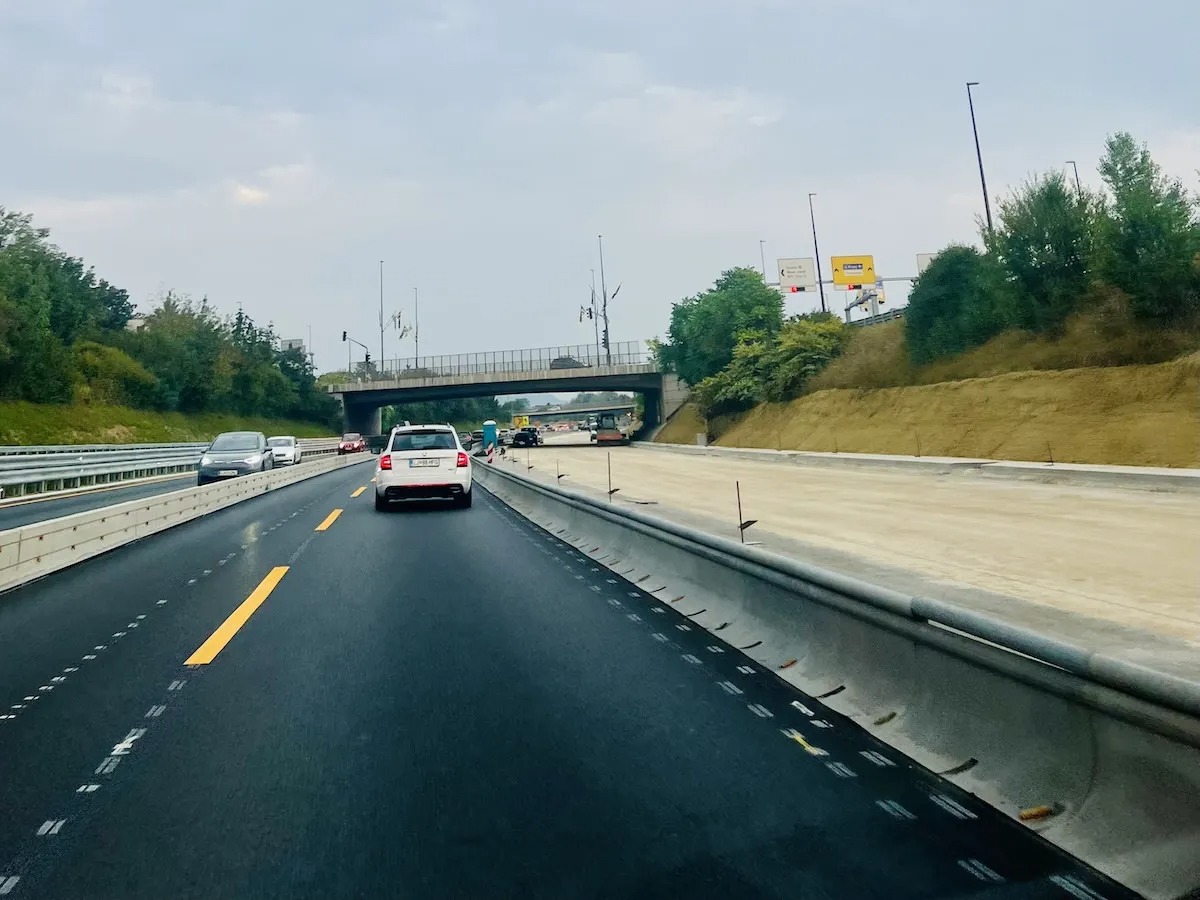
If you drive on Slovenian motorways every day, you don’t need statistics to know we have a problem. You only need a car and bad timing. The journey from Ljubljana to Domžale and back can take twenty minutes or an hour. A trip to the coast can be a pleasant outing, or two hours spent staring at the rear end of the car in front. But traffic jams aren’t just irritating. They are money. A lot of money.
- Tesla FSD Supervised in Ljubljana: My First Real-World Driving Experience
- Tesla FSD Supervised Test on Slovenian Highways and in Traffic Jams
- FSD Supervised now in Croatia too
ARSO calculated that the external costs of traffic congestion in Slovenia were already €488 million in 2021, or roughly 0.9 per cent of GDP. Of that, €357 million was linked to passenger traffic and €131 million to freight traffic. Passenger cars alone accounted for around €354 million of those costs. €488 million sounds like a lot. There is only one problem: that figure is from 2021.
2021 was still a Covid year. We were working remotely and traffic habits were rather different. If we want to understand what is happening today, we need to look at what has happened on the roads since then.
Traffic on the A1 rose by roughly 11.5 per cent in 2022, by around 11 per cent on the A2 and by around 14 per cent on the H4. In 2023, there was a further 3.2 per cent growth on the A1, 3.6 per cent on the A2 and 3.3 per cent on the H4. Then, in 2024, there was another 2.2 per cent on the A1, 4.2 per cent on the A2 and 5.1 per cent on the H4.
If we multiply those percentages properly rather than simply adding them up, we get a very interesting picture. Traffic on the A1 was roughly 17.6 per cent higher in 2024 than in 2021, nearly 20 per cent higher on the A2 and almost 24 per cent higher on the H4.
So we have an official estimate of congestion costs from a time when some of our most important roads carried a fifth less traffic than they do today. To top it off, the general price level rose by roughly 20 per cent between the end of 2021 and the end of 2025. December inflation was 10.3 per cent in 2022, 4.2 per cent in 2023, 1.9 per cent in 2024 and 2.7 per cent in 2025.
Now I can put together a model. Not an official new study, because the state clearly does not have one, but a sufficiently transparent calculation to tell us the order of magnitude we are dealing with.
If I adjust the €488 million from 2021 for roughly 20 per cent traffic growth on the main motorway corridors and roughly 20 per cent price growth, I get around €700 million a year.
Of course, traffic and congestion do not grow entirely linearly, and the total number of kilometres driven on Slovenia’s road network actually fell by 2.2 per cent in 2025 compared with 2024. So a fair current range would be roughly €650 million to €700 million a year.
A completely different cross-check lands in a similar range. If congestion still accounted for the same 0.9 per cent of GDP as in ARSO’s calculation for 2021, Slovenia’s 2025 GDP of €71.2 billion would put the figure at roughly €640 million.
Is the real current figure €640 million, €680 million or €700 million? It doesn’t matter. The point remains the same. We are talking about almost €2 million a day. Every day. Saturday, Sunday, public holidays, Christmas. Roughly €80,000 in economic damage for every hour of the day.
That is no longer small change. Then we get to time, where the cost is far easier to grasp on an individual level.
This year, SURS published new data on daily mobility. In 2025, 80 per cent of journeys to work were made by car, which is even higher than the 75 per cent found by the 2021 survey. More interesting still is why people do not use public transport: as many as 42 per cent of car passengers say that getting to work by public transport would take too long, while another 23 per cent say public transport does not run when they need it.
Slovenia currently has roughly 939,000 people in employment. If, for a very rough model, we take the 80 per cent share of car commutes and assume an average of 35 hours lost to congestion each year, we arrive at roughly 26 million lost hours annually.
Twenty-six million hours. That is more than 3.2 million eight-hour working days. If we value an hour of our time very conservatively at just €10, we are talking about an additional €260 million in lost time value. For context, the average monthly net wage at legal entities was €1,602 in 2025.
I am deliberately not adding that amount to the €650 or €700 million, because the methodologies are not the same and some effects could be counted twice. But 26 million lost hours is a fairly good indication of how much of our lives we leave on the roads.
Ljubljana shows that my assumption of 35 hours is not excessive. TomTom calculated that in 2025, a driver in Ljubljana lost 67 hours a year to congestion during peak traffic. That is more than eight working days. True, it was nearly four hours less than in 2024, so I will not claim that every year necessarily gets worse. But 67 hours of life lost to traffic alone each year is still hardly a statistical error.
Then there is tourism and leisure. In 2024, Slovenians made roughly 11.4 million day trips within Slovenia and spent an average of €75 on each one. That amounts to around €855 million in domestic day-trip spending a year.
Nobody here measures how many people look at Google Maps on a Saturday morning, see the red Primorska or Gorenjska motorway and think: “Fuck it. I’m not going today.” So I am not going to invent a number. But I can show the consequence. If traffic jams deter or redirect just one per cent of day trips, roughly €8.6 million in spending is at stake. At three per cent, it is nearly €26 million, and at five per cent, roughly €43 million.
Not all of that money necessarily disappears from Slovenia. If I go for lunch in Ljubljana instead of going to Bled, Bled loses it, not Slovenia. If I stay at home or drive across the border, that is a different story. But the fact remains that traffic chaos also affects our decisions about where and when we go.
So, to put the figures in one place: roughly €650 million to €700 million is the current order of magnitude of the annual external cost of congestion; in a conservative model of commuting alone, we lose around 26 million hours a year; a Ljubljana driver can lose 67 hours in queues, or more than eight working days; and just a five per cent impact on domestic day trips means around €43 million in potentially lost or redirected spending.
And then we hear that a traffic jam is merely a few unpleasant minutes you simply have to accept. It isn’t. Traffic jams are infrastructure, productivity, leisure, tourism and quality of life. Above all, they are a very expensive way of proving every year that standing still can be billed rather effectively too. Nobody sends us the bill. So apparently we pretend it does not exist.
Sources: ARSO – External transport costs; DARS – annual reports 2022, 2023 and 2024; SURS – daily mobility 2025, employed population, GDP, wages, tourist travel and kilometres driven; TomTom Traffic Index 2025. Data obtained with the help of AI.